Know what a product earns before you spend on ads
Other tools show you what is selling. That is the easy half. SpotPeaks prices the whole order, including the advertising it takes to find one buyer, and shows you what is actually left.
Start free trial →Plans from $29.99 a month, and Launch starts with 14 days free. Cancel anytime.
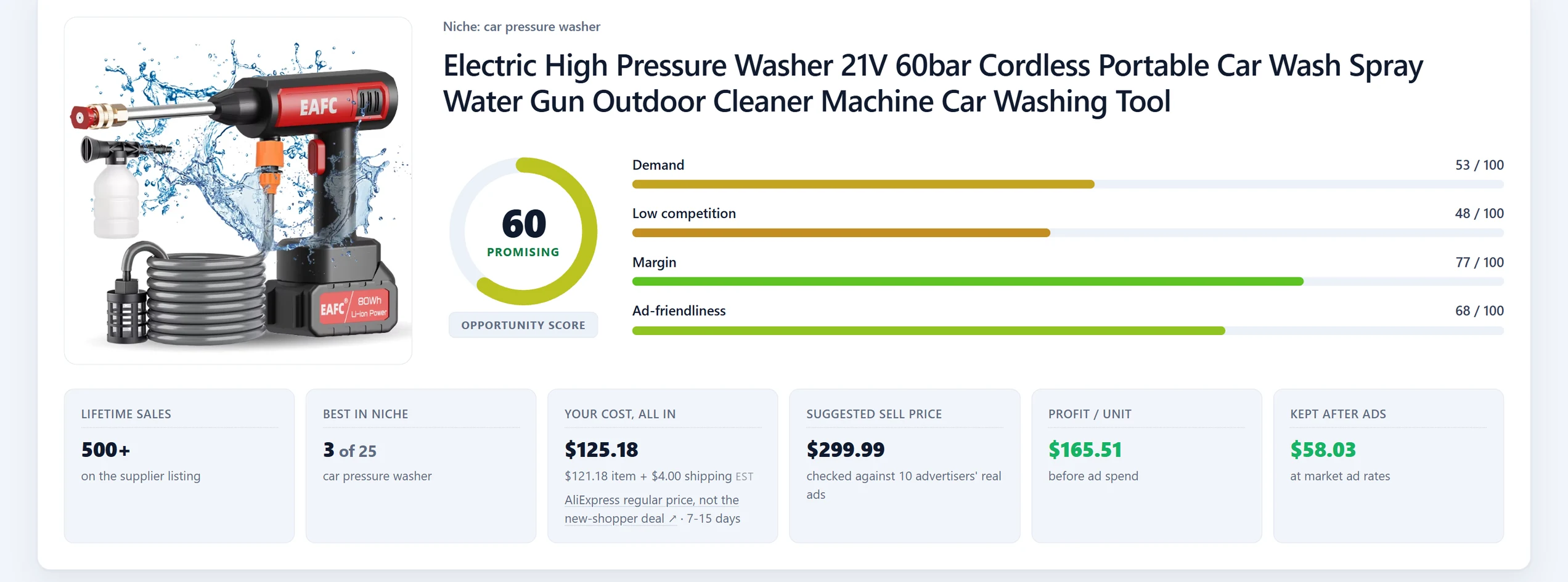
A real product page, captured from the app. The six figures across the bottom are the whole argument: what it costs you, what you can charge, and what survives the advertising.
The same six numbers, on a product that works and one that does not
This is the part most tools leave out. Both of these are real pages. They are the identical component with different numbers, and the only figure that differs in kind is the last one: what is left after you have paid for the customer.

Clears. $58.03 a sale survives the advertising.

Does not. A $15.86 margin against a $26.12 customer, so every ad-driven sale is down $10.26.
The cost of the ad is the cost of the product
A beginner does the arithmetic that feels obvious. Buy for eight dollars, sell for twenty four, keep sixteen. That number is wrong before the first sale, because the customer who bought it did not arrive on their own.
The full cost of one order is the item, the shipping the supplier charges you, the import duty if there is one, the payment processing fee, and the advertising it took to find one buyer. That last line is usually the largest of the five and it is the one nobody puts in the spreadsheet.
Every product on SpotPeaks is priced with all five in it. When the answer comes out negative, the page says so and explains which line ate the margin.
Illustration of the layout, not a live reading.
Not a markup. What sellers are actually getting
A three times markup on supplier cost is the rule of thumb every guide repeats. It is also how tools end up recommending a price nobody pays.
So we check ours against what real sellers are charging for the same thing, on marketplaces and on their own storefronts, and we say plainly when our suggestion sits above that.
TikTok Shop publishes its own sales counters, and where a product appears there we show that figure too. It is one of the few numbers in this industry that comes from the platform itself rather than from somebody's inference.
Where we have no outside evidence for a product, we say we have none rather than filling the gap with a formula. A number with nothing behind it is worse than a blank, because you will act on it.
- Landed cost broken into item, shipping and duty, each one clickable
- The price the tool suggests, and the price other sellers are getting, side by side
- A plain statement when those two disagree, instead of quietly showing you the flattering one
- Save anything you are weighing up and put two products side by side
- 41 ads running, 12 past 21 days
- 7 sellers listing the same item
- Order counter climbing
Illustration of the layout, not a live reading.
Most products do not clear, and we would rather say it
The majority of what we track cannot be sold profitably by somebody paying for traffic. Cheap items are the worst of it: when one customer costs twenty five dollars to find, a product you sell for fifteen has no arithmetic that works, no matter how many people are buying it from somebody else.
We keep those products findable on purpose. If you have already picked one, the useful thing is not to hide it from you, it is to show you exactly where the money goes and let you decide with the real numbers in front of you.
Sells for $14.99 everywhere it is advertised. Below $32.43 every sale loses money; above it, nobody in this category pays
Illustration of the layout, not a live reading.
What this cannot tell you
We cannot tell you what you will earn. Nobody honest can. The ad cost we use is a benchmark, and real ad costs move by a wide band around any benchmark, so the figure on screen is an expectation and not a promise.
We also do not model your fixed costs. The storefront subscription, the apps, the domain, the creative, and above all the products you test that do not work. None of those belong in a per order figure, and their absence is why clear profit per order is not the same thing as profit.
See products being advertised right now
Free and open, no account. Grouped by niche, with how many ads are running and how long they have lasted.
Now check one of yours
Type an idea and get the same verdict the app gives, from our ad tracking and measured sales snapshots, one answer at a time.
Same formula, same database as the Demand Check inside the app - this is not a demo widget.
What you actually get
Launch includes all of it. Research covers finding and checking products, for less.
Fair questions
Is this different from a winning products list?
A winning products list tells you somebody is selling it. That is where this starts, not where it ends. The question we answer is whether the same product still leaves you anything once the ad that found the buyer is paid for, and the answer is often no.
Where does the supplier cost come from?
Live supplier listings, plus an estimate of the shipping the supplier charges you and the import duty where one applies. Supplier listings quote their cheapest option, so we label the figure as a starting price rather than presenting it as the exact cost of the version you would actually ship.
Do I need a store first?
No. The research side works before you have set anything up, and that is the point of doing it first.
See it against a product you are already considering
Everything on this page runs against live supplier listings and ads that were still up when we last looked. 14 days free on Launch, and cancel is a button in settings rather than a support ticket.
Start free trial →The rest of it: Ad Finder · Stores · Launch · Winners · Statistics · compare tools